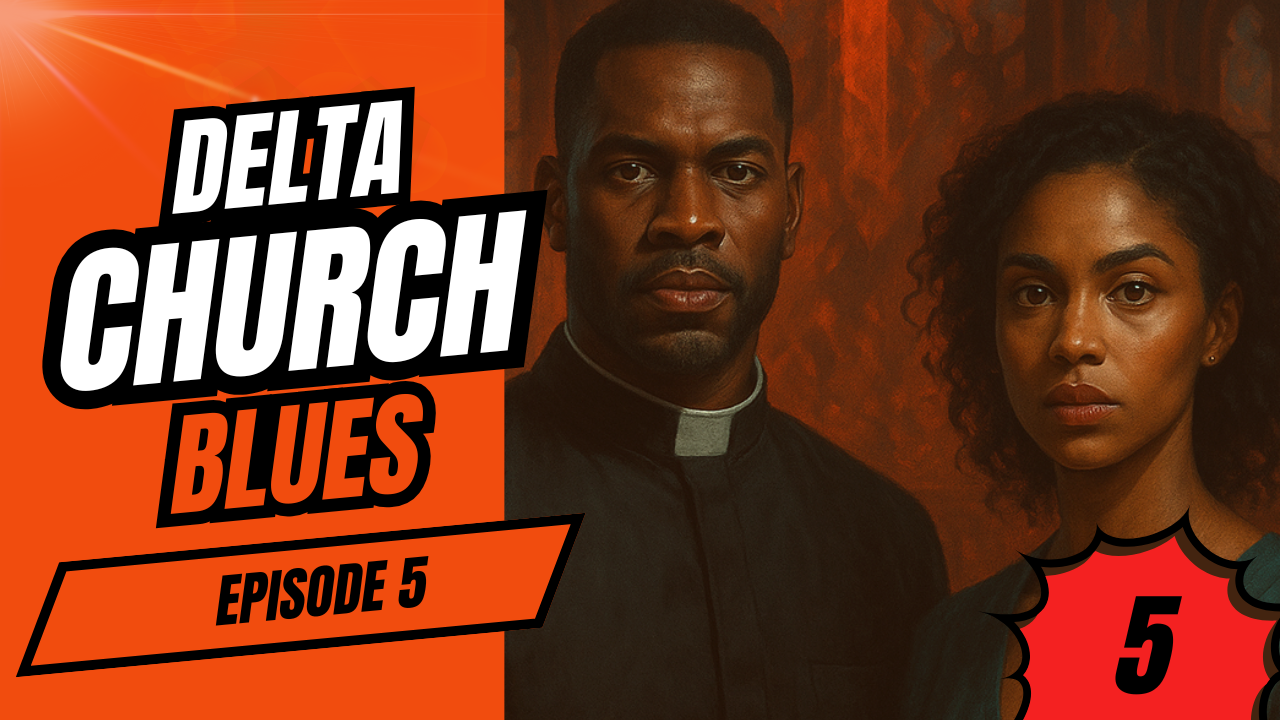
Scripture: John 10:10 — “The thief comes only to steal and kill and destroy…”
Scene 1 — The Call
The parsonage phone rang like it didn’t care who it was waking. Thomas let it ring once, twice, three times—giving grace to the universe in case it wanted to change its mind—then picked up with his Sunday-voice smoothed over weekday sandpaper.
“This is Pastor Gray.”
On the other end: a woman with a kind, tired timbre he recognized from fellowship halls everywhere. “This is Denise over at Third Street Baptist in Timmons. We’ve got a member transferring in who says he was baptized at New Jordan Christian in nineteen-eighty-something. We’re trying to update our records and, well, ours are… less than complete.” She chuckled in a way that confessed both sin and salvation. “Would you be willing to look?”
He knew what he should say: Of course, sister. Happy to help. The body is one. He said it. “Of course, sister. Happy to help.”
He hung up and stared at his own hands. They looked like two men who had done honest work and were now considering crime.
Paperwork.
He said the word out loud like a curse you use in front of children so it loses its power. “Paperwork.” He could preach down a storm, hold a widow’s hand through the midnight, talk a teenager off a ledge with nothing but jokes, gum, and a verse from Psalms—yet here he was again, chaplain to the Church of Perpetual Forms.
He paced the kitchen, ranting to the coffee maker, which had developed a pastoral counseling ministry by virtue of proximity. “I used to think the ministry was sermons and souls and maybe a few casseroles,” he told the unbothered appliance. “Turns out it’s triplicate. It’s ‘sign here.’ It’s ‘please initial that you initialed.’ It’s compliance manuals and a filing cabinet that smells like Noah took it on the ark.”
He opened the fridge, closed it, took a sip of last night’s water like it was whiskey. “If Jesus walked into New Jordan this morning and said, ‘Baptize me and let me sing ‘Total Praise’ with the choir,’ Deacon Harris would ask Him for three copies of His baptism certificate, a release for the livestream, and a background check to make sure the Lamb’s Book of Life isn’t a forged document.”
The coffee maker gurgled like amen.
“And I will do it,” he told it, jabbing the counter with two fingers, “because that’s the job. Because sheep need paperwork, too. Because if we don’t, somebody’s going to get to glory and Peter’s going to say, ‘I’m sorry, sir, but you didn’t fill out Form B-12, the one with the carbon copy where you declare whether your testimony is more narrative or expository.’”
He grabbed his keys from the hook, muttering now to the door, the hall, the ghosts of pastors long gone. “And then I’ll get to church and everyone will want to know if God is real and why He whispers through bells and whether the dark you see out of the corner of your eye is in your head or in your house, and I will smile and say, ‘Let’s begin with your middle name and the spelling of your street.’”
Outside, the morning had already broken a sweat. Cicadas tuned up like they were getting paid. The parsonage steps creaked at his weight, then remembered their manners and held.
“Fine,” he told the sky. “Fine.”
He walked to the church, the older building greeting him with the same raised eyebrow every morning: You sure? The storage room key was on the heavy ring every small-town pastor carries—the one that says, I am trusted with everything except the truth you won’t say.
He opened the door and the smell met him: paper, lemon oil, old air that had learned patience.
“Let’s go find a baptism,” he said to nobody, and stepped into the archive like a diver who didn’t check whether the pool had water.
Scene 2 — The Storage Room
The storage room was a museum where no one bought tickets. Boxes labeled with a thousand tiny lifetimes: *Kitchen Committee 1974.* *Youth Lock-In, 1992.* *Easter Cantata, Some Year Where Sister Rawls Could Still Hit the High Note.* Stacked hymnals remembered hands. Old bulletins remembered names.
Thomas ran a finger along a shelf and came away with a gray line like a boundary he was always crossing. He pulled down a box of “Clerk—Sacraments” and found what he was looking for quicker than he wanted: baptism cards in a shoebox that had once housed men’s dress shoes, size “Someday.” The card stock had turned the color of tea. He scanned names, dates, the occasional note—*Came forward with his cousin, both crying*—and felt that old ache you get when paper tells the truth about time.
“Found you,” he murmured, and set aside the card Third Street Baptist had asked for. He should have closed the box, turned off the light, returned to the parsonage to practice a smile and reheat something between bread.
But a second ledger sat half-hidden behind the sacrament files, heavier, bound in cracked burgundy that used to think it was regal. No label. No year. It had the magnetism of a locked drawer.
“Don’t,” he told himself, already doing. He brought it to the rickety clerk’s table under the flicker of a bulb that was thinking of retirement and eased it open.
The handwriting changed as decades turned. Pastors’ names he dimly remembered hearing in half-stories, half-warnings. The early pages were minutes, notes on ordinary church life: who brought pies to the sale, what to do when the building fund runs low, whether Sister Evans’ nephew should be allowed to play drums.
Then the tone shifted.
He felt it before he could name it. Margins filled with cramped whispers. Lines that should have been tidy skewed and slanted as if the hand that wrote them wanted to flee.
**Rev. Harold Ellison (1972–1976)** — Resigned abruptly. Rumors. A note found in his desk referencing the parsonage mirror; he claimed to see a woman behind him when he shaved, weeping. His wife left the next week. No forwarding address.
**Rev. Caleb Drummond (1987–1990)** — They called it “illness of the mind.” He heard bells at night, said they tolled only when she visited. She never heard them herself. The clerk’s note: *“The sound belonged to him alone.”*
**Rev. Thaddeus Reed (2008–2011)** — Finances in ruin. Preached John 10:10 and said the thief’s name was “Loneliness.” Ran off with someone unnamed, returned alone.
**Pastor Lionel Barrett (1995)** — Asked me to seal this log. He said, “Leave old wounds alone or they will bleed again.” He asked me not to write what he saw, and I am trying to honor that. But I will note this: the bells he heard were not in the square and not in his head. They came when she entered, and they stopped when she left—yet she did not hear them. He said the sound was a distance, and the distance was a sound.
Thomas closed the book like you close a door you weren’t supposed to open. He locked the storage room behind him and carried both ledgers—the baptisms, and the other thing—toward the office where the light was cleaner and his name on the door gave him courage.
Scene 3 — The Warning
Levi sat on the front pew with a hat he wore like punctuation. He was waiting on no one in particular and the Lord in general. Morning light came in the side windows, made dust look like glory.
“Levi,” Thomas said, ledger under his arm like contraband. “You got a minute?”
Levi looked at the book before he looked at Thomas. “I always got a minute for my pastor.” He patted the pew beside him and Thomas sat, feeling ten years younger and a hundred older.
“I found something in the storage room,” Thomas said, lowering his voice though the room was empty and the building itself had taken a vow of silence. He opened to the pages he shouldn’t open and turned the book so Levi could see.
Levi’s eyes slid over the lines once. Something in his jaw tightened, then un-tensed by force. He laid a flat hand on the ledger and closed it like he was tucking a child in. “Some things don’t need digging up,” he said, voice gentle but iron. “Best to leave old things alone, Pastor.”
Thomas laughed once, a sound with no humor in it. “You know that’s the surest way to make a man dig.”
“Then I said it wrong.” Levi folded his hands. “You can dig. The earth will open. It’s polite like that. It won’t tell you what else is down there until you put both feet in. And by then, well. Dirt is heavy.”
“What happened to Pastor Lionel Barrett?” Thomas asked, naming the careful hand and the careful warning.
Levi’s gaze went a thousand miles and forty years away. “He preached short,” he said. “He sang long.” A beat. “He tried to be a wall.”
“Against what?”
Levi tilted his head like he was listening to the same far-off thing Thomas had started to hear in quieter rooms. “Against what the river brings when it oversteps.” He looked at Thomas then, clear and present. “You’re trying to be a wall, too. Don’t do it alone.”
Thomas swallowed a dozen reflexes: the joke he could make, the protest, the thank you. “Am I alone?” He hated how naked the question sounded.
Levi smiled with no teeth, the kind that comes after you pay for it. “You got a woman who stands with you. That helps. It also calls things.”
“What things?”
Levi tapped the ledger. “Things that like to write their names on what they think they own.”
Thomas closed the ledger again, more gently now, as if it might spook. “You’re saying words without saying them.”
“I’ve lived long enough to know the difference between a word said and a word invited.” Levi stood, hat in hand. “You preach, Pastor. You tell the truth. You keep telling it even if you whisper sometimes. And if the bells ring, you don’t pretend you don’t hear them. But you don’t go naming everything that moves. Names are obligations.”
Levi put the hat on. “And Pastor?”
“Yeah?”
“Leave old things alone.”
He walked out like a man who had given exactly the right amount of help, which is to say: not enough.
Thomas sat there with the ledger in his lap until the church ticked once, as buildings do to remind you they are listening. He put the ledger under his arm again, picked up the baptism box with the other, and headed back to the parsonage to call Denise at Third Street with good news about someone else’s sacrament.
On the porch, he paused. The heat had sharpened. Somewhere, a child was dragging a stick along a fence in a rhythm older than music. For half a second, the air behind his left ear grew dense, like a sound had decided to become a weight. Then it passed.
He told himself it was nothing you could record.
Scene 4 — Alisha’s Visit
He had the baptism card in an envelope, stamped and addressed, which felt like a victory against entropy. The ledger sat open on his desk anyway, sulking like a cat. He wasn’t reading it. He was letting it breathe near him, which is sometimes worse.
A knock on the parsonage door broke the standoff.
Alisha stepped in with a casserole dish wrapped in a towel that had known better days and better kitchens. “Don’t ask me what it is,” she said, “just say thank you and pretend it’s your favorite.”
“Thank you,” he said, pretending. “It looks like… food.”
She rolled her eyes, put the dish on the counter, and went straight to the sink to wash her hands the way people do when they know where everything is without being told. “How’s your paperwork,” she asked with a grin that had overheard his morning rant.
He gestured at the stamped envelope. “A miracle occurred.”
She saw the other ledger before he could invent a blanket. “And that?”
“Old minutes,” he said too fast.
“Uh-huh.” She dried her hands and crossed to the desk. “You move funny when you lie.”
“I move beautifully when I lie. People applaud.” He stepped between her and the desk, then immediately felt foolish. “It’s… not good.”
Her voice lowered without effort. “Is it us-not-good or you-not-good or church-not-good?”
He thought about giving her a joke for a shield. He thought about Levi’s warning and the way the bells had put a thumb in the soft of his ear. “I don’t know yet,” he said, which was true and cowardly and the only thing he could manage. “Patterns don’t always mean prophecy.”
She studied him the way you study a wall for hairline cracks. “And sometimes they do.”
He broke eye contact first, which is not the direction he preferred to move with her. “There’s a member at Third Street who’ll get to take communion under his own name next Sunday,” he said, pointing at the envelope as if good news were a deflection device. “So at least some paper saved a life.”
She nodded, let him have that little victory, and put a hand on his shoulder in the way that makes touch feel like a sentence with verbs. “I dreamed again,” she said, so soft the room leaned in. “No face. Or too many faces. Bells like someone is counting. I woke up with Ephesians on my lips.”
He didn’t ask which verse. They shared that shorthand now—the chapter number enough to move the furniture in both their heads.
“You okay?” he asked.
“Define okay.”
“Still mean enough to correct me when my theology wears its shirt inside out.”
“Then yes,” she said, smiling despite the weight behind her eyes.
She stepped back. “You going to sing tonight?”
“Probably.” He made it sound like a chore. It wasn’t.
“Don’t sing like you’re hiding,” she said, already halfway to the door.
“When do I ever hide?”
“When you think you’re being watched.” She opened the door, turned. “You’re being watched.”
He laughed so he wouldn’t have to say Me too, and she left with a look that promised courage later or consequences now—he couldn’t tell which and didn’t deserve either.
He stood alone with the ledger and the casserole and the truth that paperwork and prophecy sometimes use the same pen.
Scene 5 — The Rival Returns
Mae’s Kitchen held lunch like a sacrament—fried catfish served on paper in a way that dared you to call it casual. The air felt like grease and grace had reached a détente. Thomas ordered a plate for the fiction that he needed food; he needed a place to sit where the church wasn’t listening.
Marcus walked in with the air of a man who stops by wherever he’s needed and never by accident. He spotted Thomas, nodded, then did that pastoral drift that made people open aisles for him. He stood at the table without asking to sit, which is a way of asking a question without language.
“Make it quick,” Thomas said, not unkind. “I’m eating a sacrament.”
Marcus glanced at the notebook on the chair beside him—the ledger tucked inside. He didn’t look long. “You think this is about you,” he said. “It isn’t. It’s about whoever stands next to you.”
Thomas set his fork down. “You rehearsed that?”
“On the drive.” Marcus half-smiled. “How’s your church?”
“Sick. Worried. Stubborn.” He took a bite to buy a second. “How’s yours?”
“You know city folk. We think we’re immune until we’re not.” Marcus leaned a knuckle on the table. “Tell her to step away for a bit. Let her come up to the city. I’ve got guest housing behind the church. She could work with our youth team for two weeks. Call it a sabbatical. Call it anything that makes this town loosen its grip.”
Thomas tasted anger in the back of his throat, familiar and useless. “That’s generous.”
“It’s necessary.” Marcus glanced toward Main Street like it had ears. “You’re in a current that pulls hardest on the person whose hand you’re holding. You know that, or you wouldn’t be looking at the table like it’s a mirror.”
Thomas picked up his fork, put it down. “I’m not leaving,” he said, meaning more than geography.
“I didn’t ask you to,” Marcus replied. “I asked you to be careful what sings through you.”
“You don’t get to talk to me about singing.”
“I’m talking about you standing in a pulpit with a mouth that’s a door,” Marcus said, tone even, tone pastoral. “Doors open both ways.”
They held eye contact long enough that the air between them tried to make a fist.
Marcus softened first. “She trusts you,” he said. “That puts her in the line of fire.”
“She’s not a shield.”
“She’s not a target either.” Marcus exhaled. “Take care of her, and if you can’t, delegate.”
Thomas smiled with half his face. “Offering to help?”
“Offering to persist,” Marcus said, and stepped back from the table. “See you tonight.”
“I sing at Miller’s,” Thomas said.
“I know,” Marcus said. “I listen.”
He left Thomas with catfish cooling, grease soaking paper, and a day that had decided to be longer than hours.
Thomas opened the ledger under the table for the single, stupid comfort of looking at a thing you should not look at. He closed it again immediately, as if seen.
Scene 6 — Miller’s Roadhouse
Neon hummed; fryers hissed; a Telecaster checked its own pulse. The room was thinner than usual, not empty but wary—the way people stand at the edge of a pond and ask it whether it remembers last year’s storm.
Miller gave the chin tilt. Not an invitation. A recognition: This is how we hold the roof up tonight.
Thomas strapped on the guitar like you strap on resolve. He didn’t make a speech—learned a long time ago that explanations kill whatever you’re trying to raise. He thumbed a low E, let it settle, then said it plain: “Ain’t No Sunshine.”
He took it slower than he’d planned, half a breath between each line like the words needed room to come true. The first verse came out tilted, pulled, not quite begging and not quite mad, the way you sing to something you love when love thinks it’s an exit. He didn’t look at Alisha. He felt where she sat.
*Wonder this time where she’s gone…* He wasn’t wondering. He was pleading with a future.
Boots at the end of the bar found a harmony line on the guitar that walked behind Thomas’s melody like a friend who refuses to leave even when you wave them off. The fryers threw punctuation on the backbeat. Somewhere, a glass met wood in the exact rhythm of *don’t, don’t, don’t…*
The room went quiet in that way that contains whispers. People held their forks halfway to their mouths and forgot to be casual. Lanelle leaned on the service door as if rest had rent due and she’d finally paid it.
He let the chorus hover and then fall—not falter, fall, the kind of drop you do on purpose so people know you’re honest. The word *gone* landed and kept landing. He could feel the space between the syllables stretch, elastic and dangerous.
He glanced over the crowd once and found her. Alisha sat near the corner, profile lit in pulsing neon, hands folded in a way that wasn’t prayer and was. She met his eyes for a heartbeat, and there it was—the confession you should never make in a room full of witnesses. He looked away first. He hated that he was getting good at that.
Second verse. He went smaller, not bigger, took his voice down to where truth thrums under the bravado. No melismas. No show. The words did their own work when you let them.
He ended without a flourish, no last-minute salvation, just the chord hanging like laundry on a line and then the line breaking.
Silence.
Then soft applause, as if clapping too loud would break something that had finally managed to hold itself together.
Miller met him at the edge of the stage with water. “You going to preach that tomorrow?” he asked, halfway to a dare.
Thomas drank and nodded, because he didn’t have language yet and might not tomorrow either. He stepped out onto the side deck where the roadhouse breath met the river’s and listened for bells he told himself weren’t there.
Footsteps behind him. He knew the footfall before it spoke.
“You sang like a man who should have lied and didn’t,” Alisha said.
“I sang like a man who ran out of lies.” He put the plastic cup on the railing, felt the wood steady his hand.
“What did Levi say?” she asked.
“To leave old things alone.”
“And you heard?”
“I heard,” he said. “Hearing and obeying aren’t married.”
“Sometimes they’re cousins,” she said, then grew quiet. “I don’t want to be anybody’s pattern.”
“You’re not,” he said quickly, and wished he sounded more convincing to both of them.
A car backfired down the street. The night held its breath, then exhaled. From somewhere far enough to deny and near enough to accuse, a single bell tolled once. He felt it more than heard it, in the cartilage under his ear, in the molars.
She looked up. “You hear that?”
“No,” he lied too fast. “Just an old engine giving up.”
She nodded like she’d file the answer somewhere she didn’t plan to visit again soon. “Don’t hide tomorrow,” she said, and went back inside with a gait that promised she wouldn’t either.
He stayed with the railing and the river and the insistence of one note still vibrating in the wood. He told it to stop. It didn’t.
Scene 7 — The Sermon & The Name
Sunday came in pale, like light recovering from a long night. The sanctuary assembled itself—ushers depositing boxes of tissues at pew ends like offerings, the organist playing so gently even the pipes seemed to whisper yes. The choir loft looked gap-toothed. People settled into their places the way geese settle into sky—by memory you can’t teach.
Thomas stood in the narthex and watched his people arrive. Sickness makes you honest in your walk. Fear makes you plural. He had a sermon like a blade and a heart like a bruise. He prayed the way you pray when you need breath more than words.
At the pulpit, he didn’t warm the room with jokes. He let the Scripture draw itself up: “The thief comes only to steal and kill and destroy.” His voice came out steady. “But I have come,” he added, and let the phrase do what it always does—pull the line into promise.
He put both palms on the wood and talked like he was tired of everything except truth. “I want to say this plainly so you don’t misquote me at lunch. The thief isn’t your neighbor. The thief isn’t the woman across the aisle. The thief isn’t the man who plays guitar on Saturday night and ushers on Sunday morning. The thief is the voice in the dark that tells you to turn on each other. The thief is the pattern that says destruction wears perfume and calls itself love. The thief is the whisper that keeps us separate and then eats us one by one.”
He saw heads nod, hands tighten on tissues, Levi’s hat resting on Levi’s lap like an amen. He felt the room edge toward the rail where fear becomes clarity.
“Steal, kill, destroy,” he said, slower now. “Maybe it doesn’t happen with knives. Maybe it happens with ink. Maybe it happens with stories we tell ourselves about how men always fall and women always push them. Maybe it happens when we baptize superstition and call it discernment.”
A murmur, the good kind. He rode it, didn’t push it. “I am not selling you a villain you can touch. You already have those. I am telling you to watch the doors of your life. Some of you leave them open because you’re polite. Some of you lock them and throw away the key and then wonder why you can’t breathe. The Lord gives locks and keys and wisdom for when to use which.”
He paced a step, felt the floorboards remember a hundred men who had done the same walk. “I’m going to ask you to do something the thief hates,” he said. “I’m going to ask you to hold each other instead of hitting each other. I’m going to ask you to believe that the person next to you is not your doom but your deliverance. I’m going to ask you to run the thief out by robbing him of his favorite tool: our agreement with our fear.”
He took the congregation to the edge of a refrain and then let them breathe. The organist laid a chord under him without asking, and the chord landed like a floor.
He reached for his close, the cadence he owned enough to offer it back. “Church, if something is trying to steal—”
He stopped.
The sound came first, not the bells, but the absence of them, the way a room sounds when the next second is too heavy for the one you’re in. The side door was open a crack to let the summer air act like it was help. Dust hung in a shaft of light like doubt deciding to be visible.
On the clerk’s table, where Sister Helen usually kept the offering envelopes and the church record book, the ledger lay open.
The pen lifted.
He saw it. He felt it in his teeth again, that hateful beloved pressure. The pen hovered a breath above the page, then tipped like a man making a decision. The nib touched paper and began to move with the steady confidence of someone signing for a delivery they had no right to.
A
The letter formed in Sister Helen’s careful hand, except she was sitting three pews back with her purse on her lap and her eyes closed in the short nap only saints can take during sermons. Her hands were absolutely not making that A. The pen was.
l
He swallowed, mouth suddenly a desert. He kept his hands on the pulpit as if it had gravity enough for both of them.
i
He looked out at the congregation on instinct, the way you look at a crowd to see if they are seeing you see. No one else reacted. An usher folded a tissue in half with skill that would embarrass origami. A baby sighed, content with his mother’s hand on his back. Levi stared at Thomas with the gaze of a man who knows what you are seeing even if he won’t admit it to himself.
s
Thomas forced breath into his lungs. “—if something is trying to steal,” he said, finishing the phrase he had abandoned, his voice an octave lower now, his cadence suddenly too slow for the room. A shout rose from the back—that’s right—and he held to the sound like a drowning man holds to a name.
h
He thought of Alisha and did not look at her. He could feel exactly where she sat the way you can feel where a wound is before you touch it.
a
The pen made the second A with tenderness that made him want to throw it. He had an urge to shout and an equal urge to pretend. He chose neither. He kept talking because that is the one spell he knew how to cast.
“—then we will not be polite. We will not be spiritual in a way that excuses cowardice. We will not call fear discernment and we will not call suspicion wisdom. We will lock what needs locking and open what needs opening and we will stand together at the threshold and say ‘not today.’”
(’s)
The apostrophe curved like a smirk.
He was sweating now in places that told on him. He gripped the pulpit and prayed his knuckles would pray back.
The pen stopped.
A drop of ink formed at the nib, swelled, and fell—a perfect period at the end of a sentence no one had given permission to write. The page breathed, if paper can be said to breathe. The room did not react because the room had seen nothing. Only the man who had been complaining about paperwork nine hours ago watched ink write his undoing.
He knew two names. One he could say any time, any place, and he did. “Jesus.” It came out under his breath, a private exhale with public consequence.
The other was hers. He didn’t say it. He didn’t even let himself think it hard, as if thought itself could drag her toward a fate spelled in stolen cursive.
He closed the Bible on the pulpit with a touch that told the room everything was normal. “We will stand together,” he said, and smiled the warm, pastoral smile he used when he needed to land a plane made of hope in crosswinds of panic. “Choir, would you lead us?”
The organist took his cue and found a hymn that promised what he had no right to guarantee. People stood. Some raised hands. Some cried soft tears at the relief of having been told they are not each other’s enemies.
Thomas looked down at the clerk’s table again. The ink gleamed black and wet in the light.
Alisha.
No one else saw. He put his hand flat on the pulpit and kept standing because sometimes the only prayer left is the refusal to fall.
The bells did not ring.
The hymn rose anyway.