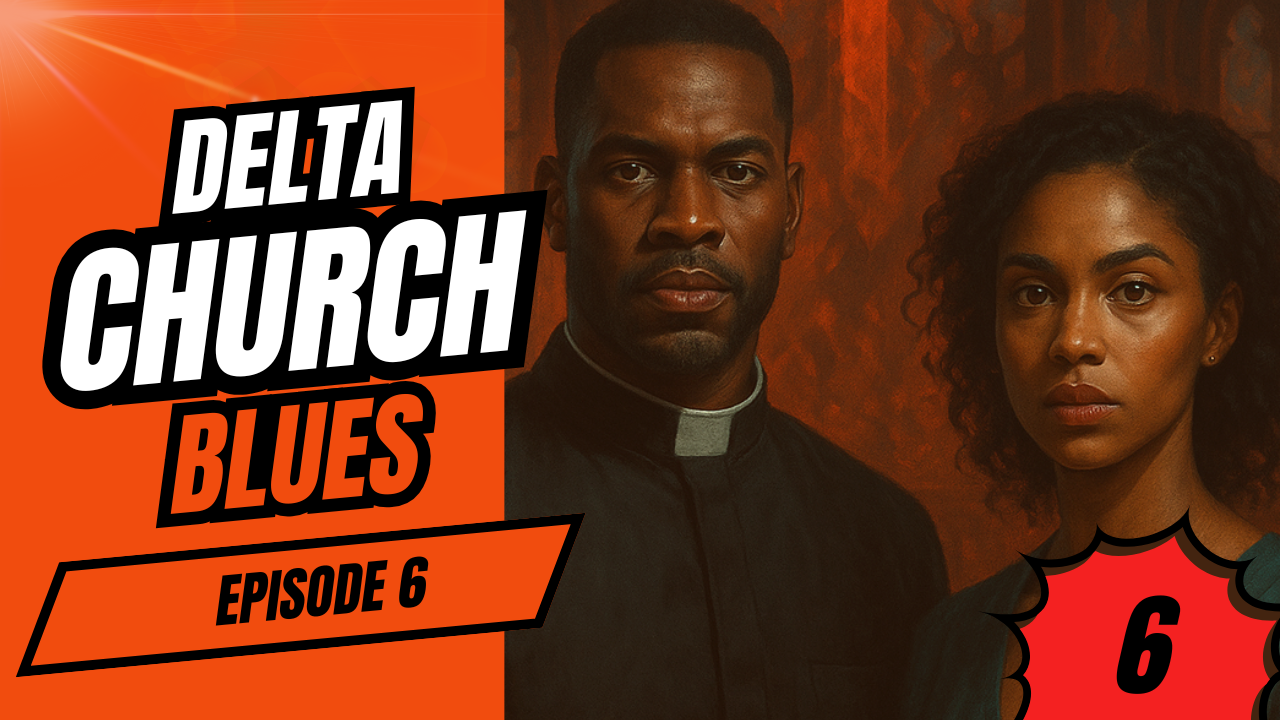
Scripture: Proverbs 18:10 — “The name of the Lord is a strong tower; the righteous run into it and are safe.”
Scene 1 – The Siege at Home
The parsonage had always creaked. Old wood, old nails, Delta humidity swelling boards until they groaned like tired men remembering wars they never fought. Thomas used to joke it off. “Every house in this town’s got arthritis,” he told Alisha once, and she laughed the way you do when the truth feels lighter with company.
But arthritis didn’t pound on walls. Arthritis didn’t rattle windows like fists with bad manners. Arthritis didn’t stomp across ceilings the blueprints swore didn’t exist.
The first night he ignored it, rolling over with a muttered curse and a blanket yanked tight. The second night he shouted at it, stomping barefoot through the parsonage with his Bible in one hand like it could double as a club. “Come on then,” he hissed to nothing, “let’s see if King James has still got a swing.”
The third night broke him. He’d just drifted into half-sleep when the bed shook so violently the lamp tipped and shattered on the floor. A low hum rose in the walls, not pipes, not wind, but something alive and mean. He scrambled up, heart clawing its way through his ribs. By the time the noise stopped, Thomas was already on the porch with his shoes half-tied and Bible clutched like a shield. He didn’t go back in.
Dawn found him hunched on the church steps, sweat-soaked shirt plastered to his chest, hair sticking in angles that made him look younger and older at the same time.
The door creaked. Alisha stepped out, hair pulled back, eyes rimmed with the redness of another night gone wrong. She wasn’t surprised to see him. That hurt worse than fear.
“It’s not just you,” she said softly. “Last night I heard bells in my hallway. Shadows crawling my walls. Even the Center—after I locked up—whispers, Thomas. Like someone saying my name.”
Her voice carried something beyond fear. Resignation. As though admitting it meant surrendering to it.
Thomas barked a laugh that had no humor in it. “Guess God’s strong tower don’t cover utilities.”
They didn’t debate their options. There weren’t any. They simply moved into the church.
Thomas hauled a blanket into his office, dropping it on the lumpy couch that smelled faintly of lemon oil and other pastors’ failures. Alisha spread hers in the nursery, under painted sheep with cartoon eyes wide as midnight moons.
They didn’t talk about how it looked. Two grown adults, one pastor, one community director, abandoning their homes to camp in a sanctuary like refugees in their own town. They didn’t talk about reputation, or gossip, or what it meant to sleep in God’s house because nowhere else would hold them.
The symbolism wasn’t lost on either of them. If God’s name was a strong tower, this was their last chance at safety.
Still, when Thomas lay down on the couch, arms folded tight across his chest, he muttered up at the ceiling:
“Some tower. Drafty as hell.”
The rafters groaned in answer, like the old bones of the church resented the insult.
Scene 2 – Searching the Scriptures
The church office had never felt so much like a cell.
The blinds leaked weak daylight in narrow stripes. The fan in the corner ticked like a metronome no one had set. Even the smell of lemon oil and old hymnals seemed sharper, like the room itself was watching him.
On the desk lay his open Bible, Proverbs 18:10 circled twice in thick black pen: The name of the Lord is a strong tower; the righteous run into it and are safe.
Safe.
He whispered the word once, just to taste it.
It landed like chalk dust in his mouth.
Thomas rubbed his temples. He had a sermon to prepare. Sunday didn’t care about demons or shadows; Sunday wanted three points and a story. That was the deal: the preacher writes the check, the congregation cashes it in amens.
But “safe” stuck in his throat. It didn’t match the rattling windows, the pounding walls, the whispers that said his name when the house should’ve been still. It didn’t match the bed that had tried to buck him like a rodeo bronc last night.
“Safe,” he muttered. “Tell that to my drywall.”
He grabbed a legal pad, scrawled “STRONG TOWER” at the top, and let the pen hover. Maybe he could spin it:
– Strong tower = God’s character.
– Safe = not absence of trouble, but presence of God.
– Application = run into the tower by prayer, by faith, by unity.
It was the kind of outline he could preach in his sleep. Maybe he had preached it in his sleep.
But the words wouldn’t stick. His pen kept sliding toward other passages, like a compass gone drunk: Psalm 133 — Behold, how good and pleasant it is when brothers dwell in unity. John 17 — That they may be one, even as we are one.
Every time he read the word “one,” the hairs on his arms stood up.
He leaned back, read aloud to the empty office: “…that they may be one, even as we are one…”
The bells answered.
Faint at first, like they’d been jogging in from another county. Then clearer, heavier, tolling right through the walls of the church as if the sanctuary had sprouted a tower overnight.
Thomas froze. Legal pad sliding to the floor, pen rolling off the desk. He wasn’t imagining this. Not anymore.
“Hell no,” he muttered. “We’re not doing this.”
He slammed the Bible shut, the clap echoing sharper than it had any right to.
“You wanna play hide and seek, God? Fine. But I’m tired of chasing echoes.”
He shoved the pad aside, kicked the chair back until it groaned. The office suddenly felt too small, like the walls had leaned in for a better listen.
He paced. Back and forth across the worn carpet. Past the filing cabinet stuffed with bulletins from potlucks long past. Past the crooked framed photo of the church softball team, all polyester and pride. Past the stack of offering envelopes on the clerk’s desk that smelled faintly of sweat and nickels.
“Safe,” he said again, louder now. “That’s what You said. Safe. Where’s the safety, Lord? Where’s the tower? All I see is termites and dust and doors that don’t lock when they’re supposed to.”
He stopped at the window, peeked through the blinds at the quiet street outside. Mae’s Kitchen across the square was opening early. A boy on a bike pedaled lazy circles, chasing nothing. The world looked normal. Which made him angrier.
He turned back to the Bible on the desk. It sat closed now, innocent, like it hadn’t just mocked him.
Thomas dropped into his chair again, buried his head in his hands, and laughed. Not joy. Not humor. The laugh of a man cornered, the laugh you make when you realize the joke’s on you and the punchline is silence.
“You wanna know the truth, Lord?” he said into his palms. “I don’t need a tower. I need a neighbor. I need You to show up like You promised. That’s it. Just show up.”
The bells had stopped. The office was quiet again.
Too quiet.
Thomas opened the Bible one more time, almost against his will. The page fell back to Psalm 133. His eyes tripped over the words: “For there the Lord commands the blessing, life forevermore.”
He exhaled. “Forevermore sounds nice.” He tapped the page, hard. “But I’d settle for Thursday.”
The fan ticked in the corner. The blinds whispered against the glass. And Thomas Gray sat in his office with a sermon half-written, a heart half-broken, and a God who, for all the noise in the world, still hadn’t shown His face.
Scene 3 – Confession in the Sanctuary
The sanctuary at night was a different creature. In the day it welcomed you with colored glass and the faint hum of the old organ. At night it was all dark ribs and hollow breath, pews lined up like tired soldiers waiting for orders that never came.
Thomas sat in the third pew, elbows on his knees, head bowed. Not praying. Just listening to the building creak and sigh, trying to decide whether wood could mourn.
Alisha slipped in without sound, easing into the pew beside him. She didn’t speak at first. She knew silence had its own weight, and sometimes you had to let it do its work before words could enter the room.
Finally, she broke it. “Funny how we both ended up here,” she said, voice low.
Thomas glanced at her. She didn’t need to explain. His parsonage was unlivable, hers no better. The pounding, the bells, the whispers — different houses, same storm. They hadn’t chosen to share the church; the church had been the only ground left standing.
He let out a bitter chuckle. “Guess we’re refugees in God’s own house.”
She tilted her head. “Better here than alone.”
Silence stretched again. Somewhere in the back, a fan ticked as it wound down.
Then she said — awkwardly, as if testing the words — “I know you believe.”
Thomas lifted his head, blinking at her in the dim light. “So you know me.”
She turned her eyes toward the cross above the pulpit. “Oh, I know you.”
He let out a bitter laugh that wasn’t quite humor. “Yeah, I believe. And what good has it done me?”
His voice rose, echoing off the rafters. “Where the hell is God, Alisha? Where was He when my family needed Him? Where was He when the house went quiet and never woke up again?”
The words spilled like a dam giving way. His fists clenched on his knees, knuckles white. “Strong tower? Don’t make me laugh. The storm knocked it flat when it mattered most. We buried futures in that dirt. We folded clothes no one would ever wear again. And God—” his throat caught, “—God didn’t even bother to send a note of apology.”
Silence filled the sanctuary, heavy and suffocating. Alisha didn’t move. She didn’t flinch. She just let his grief echo in the rafters until it had space to breathe.
Thomas pressed on, quieter now but more dangerous for it. “You know what hurts the most? I kept preaching after that. Kept standing in pulpits, telling people He was faithful. And He let me do it. He let me lie for Him. Like He enjoyed the show.”
He finally looked at her. His eyes were wild, rimmed red. “So yeah, I believe. But I’m angry as hell that He refuses to show up.”
Alisha turned then, met his gaze full on. Her eyes weren’t soft; they were steady, like river stones worn smooth by years of current. “That’s the blues, Thomas. You sing it because He hasn’t answered yet.”
He barked a humorless laugh. “Blues. Is that what this is?”
She nodded once. “It’s not disbelief. It’s not the end of faith. It’s the middle of it. You think lament makes you weak? It makes you honest.”
He slumped back against the pew, hands covering his face. His voice was muffled. “I’m tired of honesty. I want results.”
“Results aren’t faith,” she said gently.
He dropped his hands, exhaled sharp. “No. But they sure would help. If God wants me to keep standing, He better start showing up.”
Alisha leaned closer, her hand warm on his shoulder. “You just keep moving, Thomas. We’re gonna find He’s already showing up.”
He peeked at her through his fingers, then laughed — weary but real. “Now you preaching.”
She nudged him with her shoulder, faint smile tugging at her mouth. “Just let me know when you need a guest preacher.”
For the first time all night, the heaviness cracked. It didn’t disappear, but it shifted, like a burden that had agreed to share its weight.
The fan in the back clicked off. The sanctuary returned to silence, as though even the building was waiting to see what Thomas Gray would do next.
Scene 4 – Miller’s Roadhouse
Miller’s felt like a Wednesday night prayer meeting that had fallen in love with neon. Fryers hissed their own psalms, the beer taps clicked like metronomes, and somewhere in the corner a Telecaster tested a line and decided to keep its secrets. People talked low. Sickness had thinned the crowd, but the ones who came clung tighter to their stools, as if the bar rail could count as fellowship if you squeezed hard enough.
Miller caught Thomas’s eye from behind the counter and gave that chin tilt he used for everything—hello, you good, it’s time. The room wasn’t noisy, exactly. It just didn’t know what to do with itself.
Thomas walked to the little stage, guitar strap biting a familiar groove into his shoulder. No banter. No grin. He bent toward the mic like he had a confession to make and only this machine could take it.
He thumbed a slow chord and let it ring until even the fryers listened. Then he sang, no polish, no church cadence, just gravel and breath:
They say that God will make a way…in the middle of no way…but I can’t see it…
They say God opens doors..that have always been closed….please lord show it…
they say the God even knows what we need before we ask, Oh lawd do it lawd…
they say i must walk by faith..just belive it…..Lord I belive….Help my unbelief….
The last vowel hung there like a coat on a nail. Nobody clapped. It wasn’t that kind of silence. A woman near the service door pressed a napkin to her mouth. Boots, the guitarist in the corner, stared down at his hands like they’d just witnessed something private. Even the neon buzz softened, as if embarrassed to be heard.
At the back wall, half in shadow, Marcus watched with his measured, pastoral stillness. Pressed shirt. Tired eyes. Nothing about his face gave you an easy headline.
Thomas let the chord die and set the guitar down like it might break if he looked away wrong. He nodded once to the room—thanks without words—and stepped off the stage into air that felt different, like the pressure had changed a few millibars and nobody could explain why.
He pushed through the side door into the gravel lot. Night lay over New Jordan in a soft, stubborn way. You could smell the river and the fryer grease and somebody’s old cologne trying to outlive its evening. Cicadas sawed at the edges of the dark.
The door eased open behind him. Marcus came out and let it click shut, the sound finding its place between them.
They stood there a breath. Thomas studied the gravel. Marcus studied Thomas.
“Brother,” Marcus said finally, tone even, voice low enough not to carry back inside, “the flock needs faith, not contagion.”
Thomas kept his eyes on the gravel. “They’ve already got contagion,” he said. “What they don’t have is anybody telling them the truth about how it feels.”
Marcus took a step closer, not crowding, just closing the distance where words wander off. “You sang it beautifully. But that sentiment is dangerous. A pastor can’t sing doubt like gospel.”
Thomas looked up then, eyes tired and hot. “Dangerous is pretending I don’t feel it. Dangerous is lying to people who choke on the same questions every night.”
“You confuse grief with God’s absence,” Marcus replied, steady as a level line. “Your feelings are valid. But truth is bigger than your feelings.”
“Truth that ignores the body ain’t truth,” Thomas said. “It’s theater.”
A beat. The cicadas tuned up.
Marcus’s hands stayed open at his sides, not fists, not a performance—just a man holding on to his point. “Lament has its place. I’m not denying that. But lament is not the center, Thomas. It’s a doorway. You should be leading people beyond this. It’s a starting point, yes… but where are you taking them?”
Thomas’s laugh was a cut wire. “Beyond it? Beyond what’s killing us? It ain’t no damn starting point, Marcus. It is the point. If I can’t be real with God then I can’t be real at all.”
Marcus absorbed the heat without blinking. “Realness matters,” he said. “But so does direction. A shepherd must keep his people moving toward hope. Anger confessed in prayer might save them. Anger preached as conclusion will rot them.”
Thomas’s jaw worked. “You want me to hum a lullaby while the house burns.”
“I want you,” Marcus said, still calm, “to hold the line when they can’t. To be their memory when their memory fails. ‘God is faithful’ isn’t a lullaby—it’s a lighthouse. Your job is to keep it lit, even when the fog is thickest.”
Thomas stepped closer, voice down in the gravel now. “You standing on a dock talking about lighthouses. I’m in the water. It’s in my nose, Marcus. It’s in my ears. It’s in my lungs. And I’m telling you—if God’s real, He can take my cussing and my crying and my broken voice. If He can’t, then He ain’t worth the pretty sermons we write for Him.”
Marcus’s gaze softened without giving ground. “He can take it. Of course He can. The Psalms prove it. Job proves it. But those same voices don’t make lament the last word.”
“Who said it’s the last word?” Thomas shot back. “It’s the honest word. Today’s word. If I skip it, anything I say after is counterfeit.”
Marcus nodded slightly, conceding one square on the board. “Honesty without hope is cruelty. Hope without honesty is denial. I agree. But the pulpit is not therapy, Thomas. It is a place of formation. If you make your crisis their liturgy, they will live in your storm.”
Thomas stared past him into the dark a moment, breathing hard, then back. “They already live in my storm. In theirs. In ours. You’re asking me to pretend the water’s fine so the children don’t panic. I’m telling you the kids can swim better if they hear a grown man say the current is real.”
“The grown man can say it,” Marcus answered gently. “He just can’t stay there. He must point.”
“Point to what?” Thomas’s voice cracked. “To promises the fever won’t cash? To a tower that doesn’t hold? You want me to sell assurance I don’t feel. That’s a sin, Marcus. I won’t do it.”
“Then point to a Person,” Marcus said, almost a whisper. “Not a feeling. Not a result. A Person. Even when you can’t sense Him. Especially then. That’s leadership.”
Thomas’s mouth twisted. “Leadership is telling the truth even when it kills your job.”
“Perhaps,” Marcus said, faint ghost of a smile, “but it shouldn’t kill your people.”
Silence opened again. A car eased along the street and kept going. Inside, someone laughed too loudly at nothing. The night put a hand on both their shoulders and waited to see who would move first.
Thomas broke it. “You ever been angry at Him?” he asked. “Not in theory. In your bones.”
Marcus’s eyes went somewhere else for a half-second, then returned. “Yes.”
“And you preached hope anyway,” Thomas said, not a question.
“I preached Christ,” Marcus said. “Some Sundays He sounded like hope to me. Some Sundays He sounded like silence. But He was Lord either way.”
Thomas huffed out air. “That sounds like the kind of sentence that gets printed on a bookmark.”
“It sounds like a sentence that kept me from drowning,” Marcus answered, no edge, just history. “And it kept them from drowning with me.”
A door scraped inside. Boots plucked a scale you could hear through the wall if you wanted to.
Thomas shook his head. “You think I’m going to make lament the whole religion.”
“I think,” Marcus said, “you’re standing at a cliff, and the wind is loud, and you’re sure the right thing to do is step forward and prove you’re not afraid.” He spread his hands, a pastor’s benediction without the words. “I’m asking you to tie a rope before you do.”
Thomas stared at him, all the jokes burned out for the night. “You hear what I sang,” he said, voice low. “I believe. I do. Help my unbelief. That’s the rope.”
Marcus considered that, then nodded once. “Then keep the knot tight.”
They let that sit. For a long moment it felt like the argument had climbed as high as it could and was now standing there, both men breathing, both men still not moving.
Marcus cleared his throat. “Look—lament is a language of faith. I’m not here to confiscate your tongue. But think about where you lead them with it. You are not just telling the truth; you are training their truth.”
Thomas’s eyes flicked back toward the door, toward the room where folks were trying to outlast something they couldn’t name. “Maybe training them to tell God the ugly parts is the only curriculum I’ve got right now.”
“Then teach it well,” Marcus said. “And don’t forget the second half of the sentence when your breath returns.”
Thomas’s mouth bent into something almost like a smile, there and gone. “You really think there’s a second half coming.”
“I think,” Marcus said, steady as the river, “He hears you whether you do or not.”
They stood in the hum of the sign and the saw of the insects and the breath of a small town that didn’t know it had gone quiet to listen.
“Brother,” Marcus added after a beat, the iron returning to his silk, “this isn’t a fight I’m trying to win against you. It’s a fight I’m trying to help you not lose against yourself.”
Thomas’s reply arrived from somewhere deeper than argument. “It ain’t a debate class for me, Marcus. It’s a house with no upstairs making footsteps anyway.”
Marcus’s eyes said he believed him. “Then don’t stand in it alone.”
They both looked down at their shoes like there might be instructions written in the gravel.
Finally, Marcus extended his hand. Thomas took it, firm. The grip lingered, turned into that familiar handshake that slid into a brief, respectful hug. No performance. Just recognition.
Marcus leaned back, steady, voice low but clear. “I hope you get where you need to go, brother.”
He stepped off into the dark, unhurried, as if the night had to make space for him. Thomas stayed a while, listening to the door swing open and shut behind the rhythm of the room, the small noises of people trying to be people. Then he looked up at the sky like it might meet him halfway and walked back inside, the song still trembling in him like a struck bell that refused, for the moment, to stop.
Scene 5 – The Attack Inside
The church had never felt this awake at midnight.
Thomas snapped out of a thin sleep when a hymnbook hit the floor with a crack that could’ve been a gunshot. He jerked upright on the office couch, breath fogging the dark. His heart hammered loud enough he half-expected it to echo through the sanctuary speakers.
Another thud. Then another.
He slid his shoes on without socks, whispering a curse half-drowned in prayer, and stepped into the hall. The air carried a damp chill—wrong for a summer night—as if the Delta had pulled its sheet over the building. He could smell old polish, dust, and that faint metallic tang sanctuaries get when a storm’s in the county.
The sound came again: one hymnal sliding off a pew, spine scraping wood before it landed with a slap. Then a pew creaked, slow and deliberate, the way wood moves under weight.
Except the pews were empty.
Thomas clenched his jaw. He lifted the Bible in his right hand like a hammer and walked toward the sanctuary doors. The brass handles were cool—too cool. He eased one down and stepped into a room that looked like itself but felt like an imitation wearing its skin.
Moonlight knifed through stained glass, painting fractured blues and reds across the aisles. Pews stood in their rows like soldiers at inspection, but the air around them had current, a low tide tugging the edges of the room.
From the nursery hallway, soft feet. Alisha emerged, hair disheveled, pajama top swallowed by a cardigan, Bible clutched to her chest. Her eyes were wide but steady.
“Thomas?” she whispered.
“I hear it.” His voice sounded hoarse even to him.
They moved together down the center aisle. The carpet gave a little under their steps like a breath held too long. On the third pew to the left, a hymnal slid from the endcap and fell, pages splaying like a hand that had lost its grip.
A whisper traced the air. Not words. The shape of words. The cadence of someone practicing a name before daring to speak it.
Thomas’s knuckles went bloodless on the leather cover. “Show yourself!” His voice cracked the air like a whip. “Stop hiding!”
The whisper swelled, overlapping, pressing against the walls. One pew creaked, then another, then another, until it sounded like the entire congregation rising for benediction. Hymnals toppled in a staggered rhythm, a paper storm scattering across the carpet. Somewhere up in the loft, a pedal on the old organ depressed with a hollow wheeze, like a note exhaled by accident.
Alisha didn’t step back. She planted her feet as if she intended to take root. Her lips moved, too soft to hear at first, then clear: “The Lord is my light and my salvation—whom shall I fear? The Lord is the strength of my life—of whom shall I be afraid?”
The pressure thickened. It had weight now—a push in the chest, a cotton packing in the ears. Thomas felt it puddle in the hollow of his throat, felt the old house-with-no-upstairs feeling crawling his spine. He lifted his head and shouted, raw: “If You’re there—either of You—then come on! Stop playing!”
The ceiling fans whirred to life without power, blades turning slow and menacing, stirring air that shouldn’t move. Shadows trembled across the stained glass as if something outside wanted in and kept changing its mind. The whispering multiplied. Two voices. Then five. Then many—a murmur like a crowd in another room, just on the edge of deciding to enter.
“Thomas.” Alisha’s voice, steady. He glanced over. She nodded once, the signal you give a partner on the count of three. She lifted her chin and began to sing, low at first, the words trembling but true:
“Amazing grace, how sweet the sound…”
Her voice put a candle in the wind and dared the wind to behave.
Thomas’s throat fought him. His first note came out broken, a crack more than a tone. He swallowed and found it again, rough, tuneless, but strong:
“…that saved a wretch like me…”
Something in the room paused. Not silence exactly—more like the air reconsidered its plan. The pew in the front row gave a lonely groan and fell quiet. The organ pedal released with a sigh.
They kept going, verse giving way to verse, not because they’d planned to, but because stopping felt like giving their backs to a dog that had not decided to bite yet. Alisha carried pitch; Thomas carried weight. Their two voices didn’t blend so much as lock elbows.
“I once was lost, but now am found…”
The whispers faltered, scattered like sparrows when a door opens.
“Was blind, but now I see…”
The fans kept turning but lost their menace, blades floating through lazy circles like they remembered their real job. The heaviness peeled back the way fog does under a slow sun.
They reached the verse you sing when you need the room to remember its own spine.
“Through many dangers, toils, and snares,
I have already come…”
The murmurs that had been testing the walls thinned to a thread, then to nothing. A single hymnal on the far aisle flopped open and lay still, its ribbon like a tongue that had given up.
“’Tis grace that brought me safe thus far,
and grace will lead me home.”
When the last word died, the sanctuary did not bounce it back. It absorbed it and rested. No whispers. No creaks. No self-moving books. Just the after-sound of two voices hanging in the rafters, thin but unbroken, like a line thrown from shore to shore that hadn’t found where to tie yet.
They stood breathing. Thomas hadn’t realized how hard he’d been gripping the Bible until his fingers unclenched and blood returned with pins of fire. He leaned against the end of the pew, forehead damp, pulse in his ears finally climbing down.
Alisha lowered her Bible, the cardigan slipping off one shoulder. The whites of her eyes shone in the low light, but her voice didn’t shake. “Together, Thomas,” she said, soft but certain. “That’s the only thing it fears.”
He looked at her, sweat shining at his temple. For once, he didn’t argue the premise, didn’t salt it with sarcasm to make it safer to swallow. He nodded, a precise movement, like a man counting a fact he intended to use again.
Up in the loft, something small settled—maybe wood, maybe nothing. The fans coasted to a stop on their own, one blade on each clock pointing down like a teacher’s finger to the aisle where their voices had made their stand. Thomas thought—just for a second—he heard a thin overtone riding the silence, the kind you sometimes hear when two notes kiss and make a third. Not a bell, exactly. But the shape of one.
They stayed a while longer, not speaking, just listening to the room relearn its size. When they finally moved, they moved together, steps matched without trying, picking hymnals off the carpet and setting them back in their homes. The small work of order after a night that had not deserved it.
At the front pew, Alisha paused with a book in her hand. “You see it?” she asked.
“See what?”
She nodded toward the center aisle. “We didn’t make a plan. But we didn’t stand apart.”
Thomas followed her line of sight, then shook his head with a breath that almost wanted to be a laugh. “Together,” he said, repeating her word because it had earned the echo.
He set the last hymnal down and straightened, the old ache behind his ribs quiet for the first time in days. It didn’t leave. It just agreed to ride in the back seat instead of grabbing the wheel.
The sanctuary held its peace like a covenant, daring them to break it. Neither did. They walked out side by side, and when the doors swung shut behind them, it sounded—for once—like wood minding its manners.
Scene 6 – The Sermon: Where Are You, God?
Sunday morning staggered in like a man who’d been drinking all night. Pale light pushed through the windows without enthusiasm. Ushers laid tissue boxes on pew ends like they were communion trays. The organist played scales softer than a hum, as if even the pipes didn’t want to raise their voice.
The congregation filed in slower than usual. Some carried coughs that rattled in their ribs. Some carried silences heavier than bags. Even the kids were subdued, walking close to their parents instead of racing to claim pew space.
Thomas stood in the narthex, watching. He didn’t smile, didn’t shake hands. He couldn’t manufacture warmth today. He carried a Bible under his arm and a weight in his chest, and both felt heavier than they should.
Alisha slipped in beside him, hair pulled back tight, shoulders squared as if she were bracing against wind only she could feel. She glanced at him once, no smile, no words. Just presence. Then she walked forward, sat on the second pew left side. Close enough he could see her, far enough she wasn’t shielding him.
The choir loft looked thin, half the voices missing. Levi sat three rows back, hat on his lap, gaze fixed on Thomas like he was measuring what kind of man would walk to the pulpit today.
Thomas stepped forward. His shoes sounded too loud on the wood. He laid the Bible on the pulpit, opened it to the marked page, and read:
“The name of the Lord is a strong tower; the righteous run into it and are safe.”
He let the words hang, then looked up. His voice came out gravelly, tired.
“Safe. That’s what it says.”
He paused, scanning the room. “You ever hear a word and wonder if it’s laughing at you?”
A cough somewhere in the back. A few uneasy chuckles, the kind people make when they want to help but aren’t sure how.
“Safe,” Thomas repeated. “Tell me where that tower was when fever stole a child from his mother. Tell me where it was when my family laid down and never woke up again. Tell me where it is now—when walls shake and whispers write our names. Tell me where it is when the only rest you get is because your body gave up before your spirit did.”
Murmurs rippled, half discomfort, half agreement.
“This book says we run into His name and we’re safe. But what if you run, and the tower’s got termites? What if you run, and the door don’t open? What if you run, and you find out it’s just another wall that falls when the wind gets loud?”
A woman near the aisle whispered, “Help us, Lord.”
Thomas gripped the pulpit, leaning hard. “I’ve preached that verse like it was geometry: two points make a line, a tower makes you safe. And maybe that’s enough for some of y’all. Maybe it used to be enough for me. But not anymore.”
His voice dropped. “I need to tell the truth this morning. Not the Sunday School truth. Not the poster-board truth where the rainbow always lands in your backyard. I need to tell the blues truth. The truth with a limp. The truth you whisper when you’re too tired to lie and too honest to shout amen.”
He pounded the pulpit once, not hard, but sharp. “Where are You, God?”
The words cracked the air. Silence after. The kind of silence that checks whether you really meant it.
“I’m not asking the theological version,” Thomas said, softer now, voice almost breaking. “I know the test answer: omnipresent. Everywhere. Alpha and Omega. I’ve graded those papers. But I’m not giving a test this morning. I’m giving a testimony. And my testimony is this: I can’t find Him. Not in the house that shakes. Not in the night that whispers. Not in the grave that swallowed my family whole.”
Gasps. A couple of heads bowed. Levi’s jaw tightened, but his eyes stayed steady on Thomas.
“They say God will make a way,” Thomas said, voice climbing. “In the middle of no way. But I can’t see it. They say God opens doors that have always been closed. Please, Lord, show it. They say God even knows what we need before we ask. Oh Lord, do it, Lord.”
“They say I must walk by faith, just believe it.” His voice broke. “Lord, I believe. Help my unbelief.”
The sanctuary breathed like one chest.
“This ain’t a victory service,” Thomas pressed. “This is a grievance service. Today we file our complaint with the Almighty. Today we stand here and say, ‘We ran to the tower, Lord, and it didn’t hold. We need You to answer for it.’”
A voice called from the back, tremulous but strong: “That’s right, Pastor.”
Another: “Tell it!”
Thomas nodded, fire catching in his chest. “Don’t clap for me. Don’t amen for me. Cry out with me. Where are You, God?”
The first time he said it, it was raw, desperate. The second time, it was sharper. The third time, he roared it until his voice scraped.
“Where are You, God?”
The congregation hesitated, like people at a river’s edge testing if the water would hold. Then a few voices joined: “Where are You, God?”
It swelled, hesitant at first, then stronger. A chorus of grief and faith welded together.
“Where are You, God? Where are You, God? Where are You, God?”
The rafters carried it, the floorboards trembled with it, and the air thickened, holy and dangerous all at once.
Thomas gripped the pulpit, voice ragged, eyes wet. “I believe. I do. But if You want me to keep standing, Lord, You better start showing up. Show up in this church. Show up in this sickness. Show up in this storm that don’t respect walls. Show up in the silence where my prayers used to find an answer.”
The congregation shouted back: “Show up, Lord! Show up!”
Alisha rose to her feet, hands raised, voice breaking but clear: “We’re still here, Lord! We’re waiting!”
Children cried without knowing why. Elders rocked in their pews, humming low moans that blended with the chant. Levi’s voice rang like gravel through a well: “Answer us, Lord.”
Thomas leaned into the pulpit, shouting over them all. “We ain’t asking for riches. We ain’t asking for ease. We’re asking for You. Where are You, God?”
The chant thundered now, rhythmic, relentless. It sounded less like church and more like a march, like a people demanding their King account for Himself.
Thomas slammed his palm flat on the pulpit. “If You’re listening, we’re not whispering polite anymore. We’re not trimming our prayers to fit a Hallmark card. We’re giving You the blues, Lord, raw and uncut. Where are You, God?”
The roof held the sound. The walls shook not from malice this time, but from the force of voices refusing silence.
And for one long, impossible moment, it felt like heaven had to answer.
Scene 7 – The Locked Doors
The sanctuary was still ringing with it — Where are You, God?
The chant hadn’t faded so much as hovered, a storm that had run out of thunder but still carried lightning in its clouds. People were catching their breath, dabbing their faces, rocking in the pews like they’d just walked through a furnace and weren’t sure yet if they’d burned or been purified.
Thomas stood at the pulpit, chest heaving, voice torn raw. His hands trembled on the wood. He felt drained, hollow, but also alive in a way that frightened him. He had said what couldn’t be unsaid. He had turned the pulpit into a courtroom and subpoenaed heaven. And for a heartbeat, he thought he might’ve won.
Then the doors slammed.
The double doors at the back of the sanctuary crashed shut so hard the walls shuddered. It sounded like thunder trapped inside wood. Gasps rose from the pews. Several people flinched, a baby cried out.
Thomas froze, eyes darting to Alisha. She was already on her feet, scanning the sanctuary with wide eyes, jaw set.
The locks clicked. One by one. You could hear them—solid, deliberate turns, as though invisible hands were sealing them in. Click. Click. Click.
Whispers rose. At first faint, like the sound of pages turning in a far-off library. Then closer. Layered. Overlapping. Dozens of voices, maybe hundreds, all speaking at once, all shaping the same syllables until the air itself trembled.
Thomas’s name.
Alisha’s name.
Over and over, tangled together.
The sanctuary lights flickered. Not a power surge — this was older, stranger. The bulbs dimmed, flared, then dimmed again, shadows stretching long across the pews until faces looked carved, ancient.
People shifted, panicked. One woman tried the side door; it rattled but held fast. Someone cried out, “Jesus!” and the name cracked against the whispers like a spark on wet wood — bright, then swallowed.
Thomas gripped the pulpit, knuckles bloodless. His body wanted to run, but his feet rooted. He felt it in his ribs, in his teeth — the sound wasn’t just around him, it was inside him, crawling through bone.
“Stay together!” he shouted, though his voice was almost drowned in the swirl. “Don’t scatter!”
Levi rose slow from his pew, hat pressed to his chest, and began humming a low moan. Others caught it, but the whispers drowned it before it could grow.
The footsteps came next. Circling. Heavy, deliberate, pacing around the sanctuary. First behind them, then beside them, then impossibly on the balcony above where no one stood. Shoes on wood, steady, unhurried, like a predator deciding whether to pounce.
The congregation turned in every direction, eyes wide, searching. But there was nothing to see — only sound, and the sense of being hunted.
Thomas shouted again, throat raw: “Where are You, God? If this is Your house, claim it!”
The pulpit shook beneath his hands. The whispers surged louder, now chanting his name and Alisha’s together, a chorus of mockery.
And then the bell tolled.
Once.
Deep.
Final.
It was not the town bell. It was not any bell New Jordan owned. It came from nowhere and everywhere, from marrow and rafters, from blood and stone. The sound pressed into their chests, heavier than grief, heavier than fear, so heavy it bowed spines and bent knees.
Several people fell forward into their pews. A hymnbook clattered to the floor. The cry of a child cut off as if the sound itself had hushed him.
Thomas locked eyes with Alisha across the sanctuary. She was standing, trembling but unbroken, lips moving in silent prayer. He thought — or maybe only hoped — he could hear her whisper: together.
The lights flickered one last time, then steadied, humming faint as though nothing had happened.
The footsteps stopped.
The whispers died.
The locks sat still, bolts turned.
Only the echo of the bell remained, trembling in their bones long after silence reclaimed the room.
Thomas’s hands slid from the pulpit, palms slick with sweat. His voice, when it came, was barely audible:
“Something answered.”